
DockVMap
View on GitHub
A self-hosted Docker/OCI registry proxy that gives you a stable tag pointing at a real image version you control.



What it is
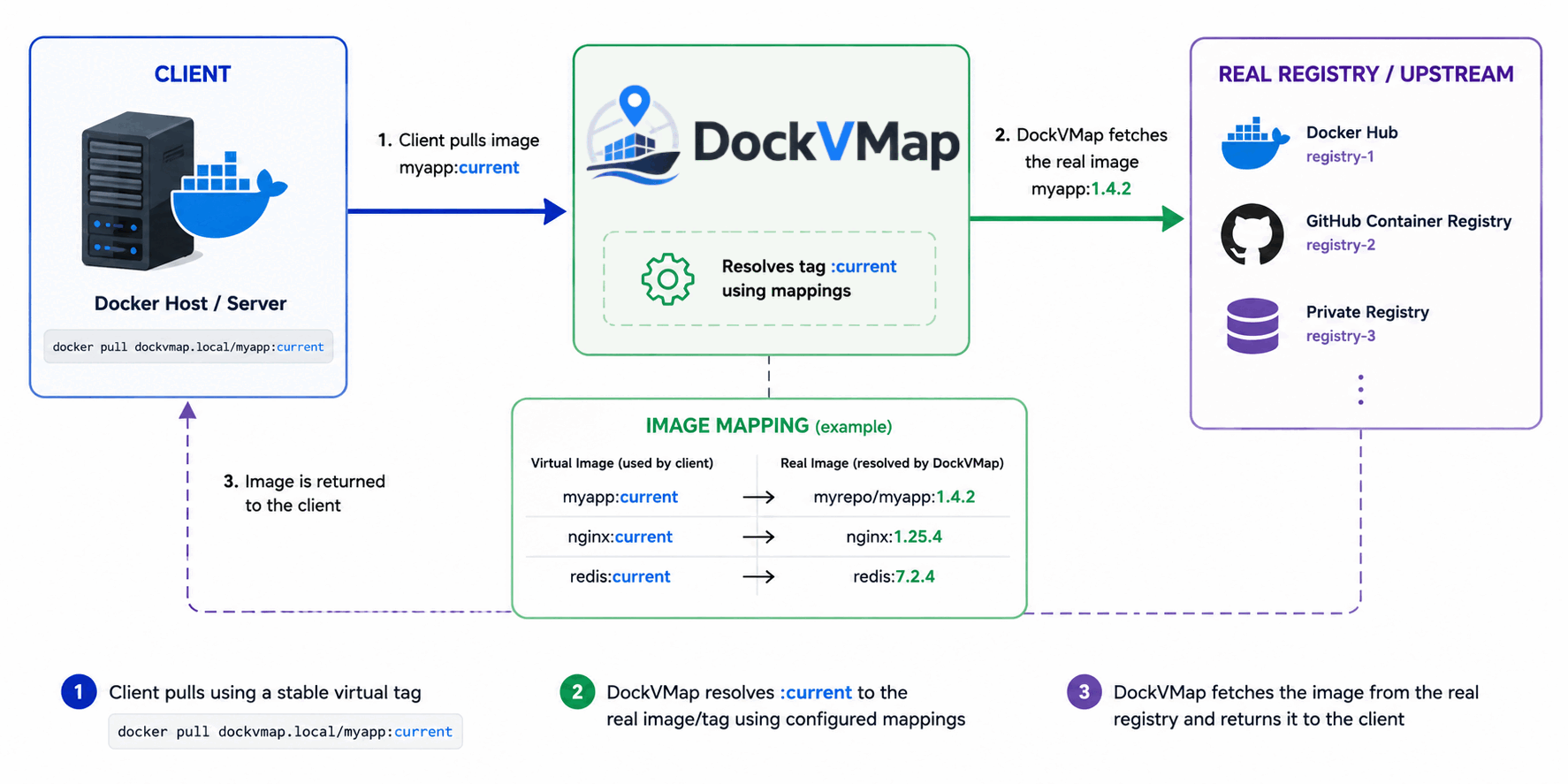
DockVMap sits between your Docker clients and a real registry (Docker Hub, GHCR, a private registry, or anything speaking the OCI Distribution API). You point clients at a virtual tag, e.g.:
docker pull dockvmap.local/myapp:currentcurrent isn’t a real tag on the upstream registry. It’s a pointer DockVMap maintains. Behind it, you track a real upstream tag (myapp:1.4.2, say) per image, and change what current resolves to whenever you decide to, from a web UI. Clients never change what they pull; you change what they get.
Why
:latest moves under you with no warning and no audit trail. Hardcoding a specific version tag everywhere it’s referenced means every rollout is a find-and-replace across configs. DockVMap adds one layer of indirection so you get a fixed, predictable reference for clients and full control over what it actually resolves to, plus a record of when it changed and to what.
Screenshots
Features
- Virtual tag proxying: OCI Distribution API proxy (
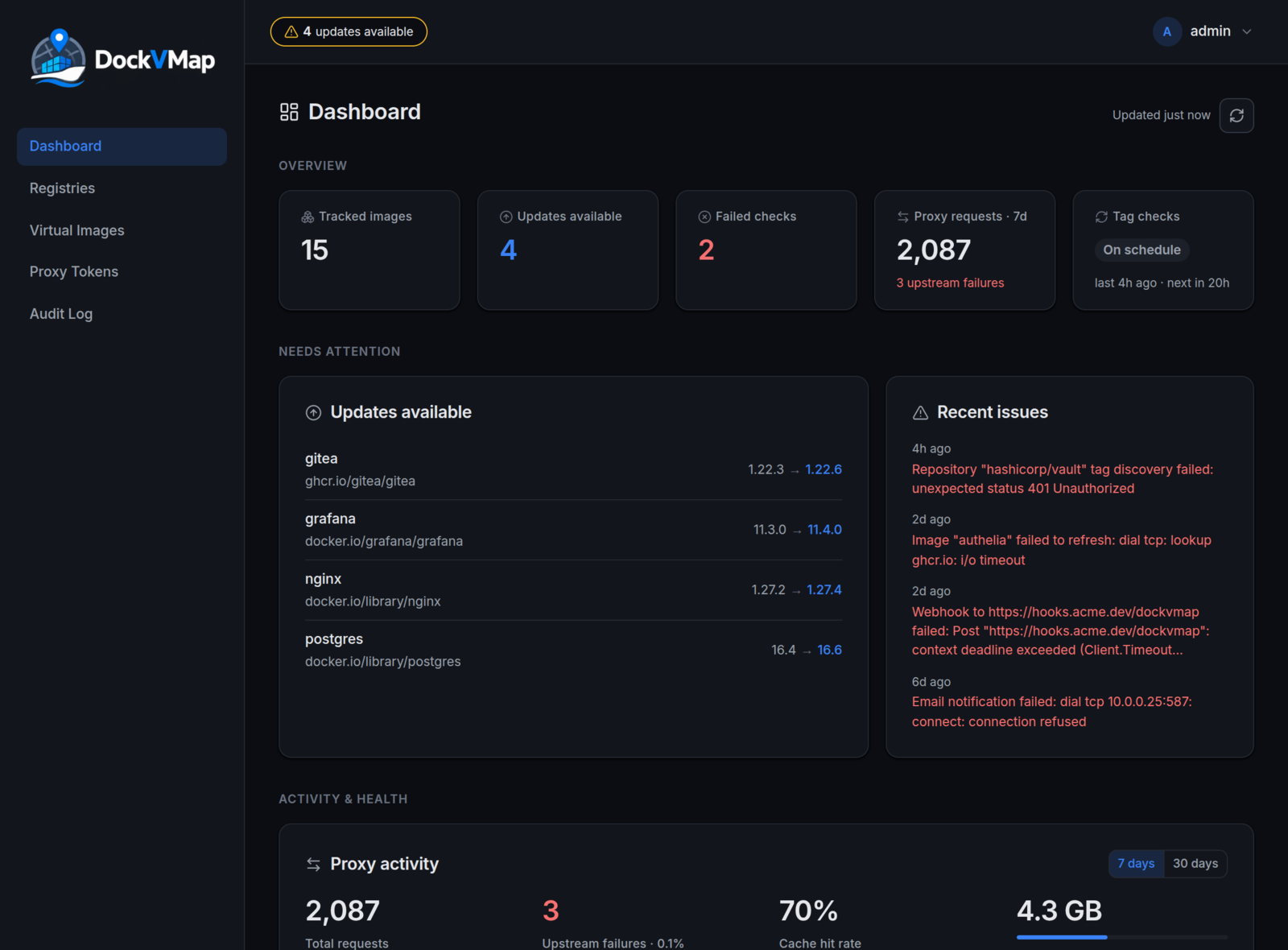
/v2/...) that transparently resolves a stable tag to whatever real tag an image is currently pinned to. - Tag family analysis: inspects a repository’s real tags, groups them into families, and tells you when a newer tag in the same family becomes available.
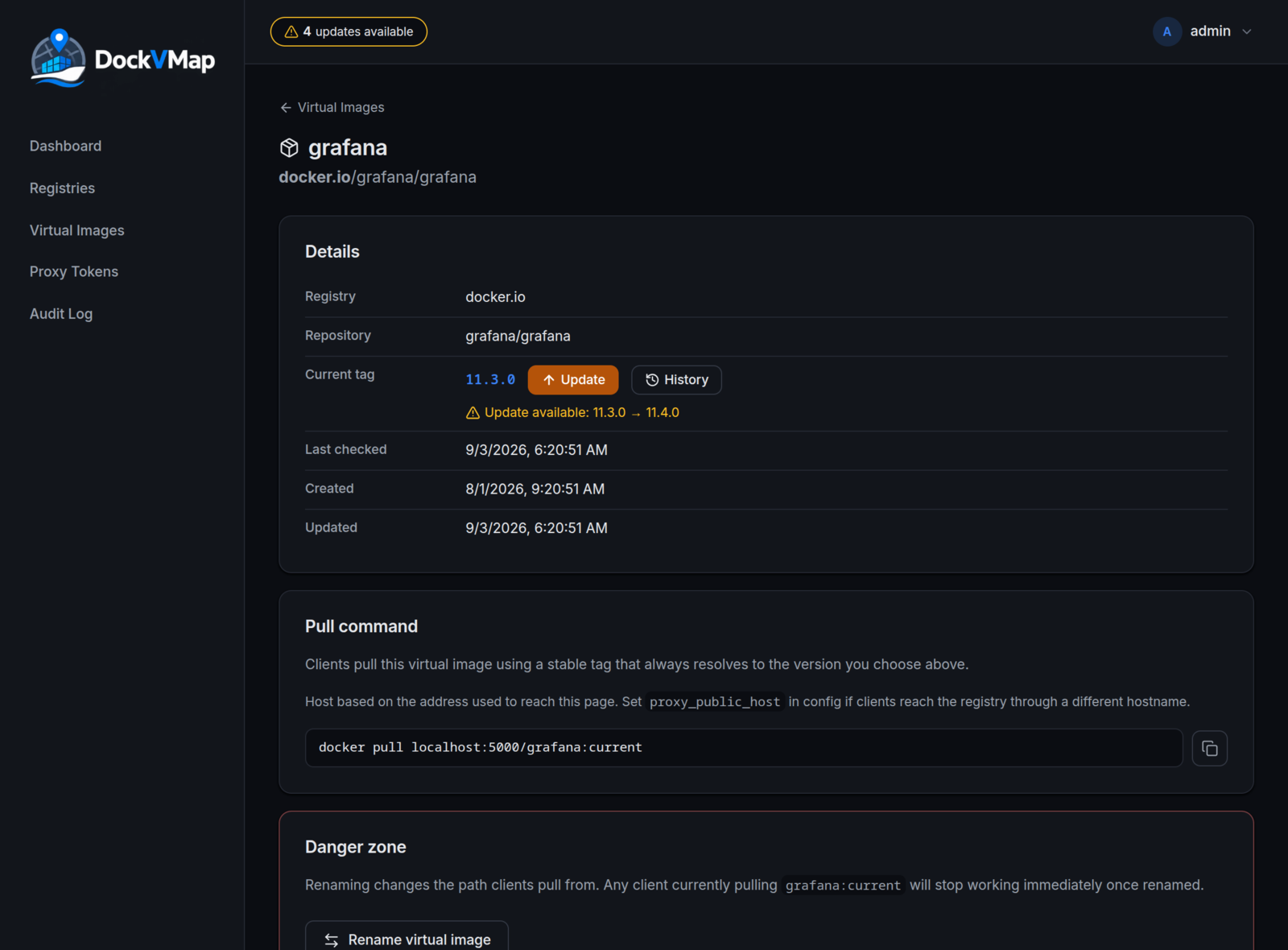
- Pinning: park an image on its current tag from the details page. Upstream tags are still fetched and recorded, but no update is flagged and no upgrade email is sent until you unpin.
- Tag discovery: when adding a virtual image, scans the upstream repository in the background (result cached) so you pick from its real tags instead of typing one blind.
- Tag history: per-image record of every real tag the virtual tag has resolved to, and when each change happened.
- Web UI: Svelte SPA for managing registries, virtual images, and reviewing what changed and when.
- Notifications: email (SMTP) and/or generic webhooks when a tracked image’s tags change. Email volume is selectable per account (every tag change / only when an upgrade becomes available / off); webhooks always fire and carry an
updateAvailableflag. - Optional blob cache: on-disk manifest/blob cache keyed by digest, to cut repeated upstream pulls.
- Proxy authentication: optional HTTP Basic Auth (via issued tokens) in front of the registry proxy itself.
- Audit log: every state-changing action recorded, with resolved client IP and actor.
How it runs
One binary, one SQLite database, three things running inside it:
- a proxy server implementing the OCI Distribution API,
- a web server serving the REST management API and the embedded frontend,
- a background worker doing tag refresh, notifications, and cleanup on independent schedules.
Quick start
The recommended way to run DockVMap is the published Docker image. It bundles the binary with the frontend embedded, and needs only a persistent /data volume (SQLite database, credential key, blob cache) and the two ports: 5000 for the registry proxy, 8080 for the web UI.
docker run -d --name dockvmap \
  -v dockvmap-data:/data \
  -p 5000:5000 -p 8080:8080 \
  ghcr.io/septi0/dockvmap:latest
Open the web UI at http://localhost:8080. The first visit walks you through creating the initial admin account. Point Docker clients at the proxy on :5000.
Pass any config as DOCKVMAP_* environment variables (-e DOCKVMAP_TRUSTED_PROXIES=gateway, etc.; see Configuration for the keys). A credential encryption key is generated and persisted to the volume on first run, so registries that require auth work with no upfront setup.
Images for linux/amd64 and linux/arm64 are published to ghcr.io/septi0/dockvmap on every v*.*.* tag, as latest, MAJOR.MINOR, and the full version.
Docker Compose
compose.sample.yaml is a documented starting point; copy it to compose.yaml, adjust, and docker compose up -d. It runs the same published image, persists /data to a named volume, publishes both ports, and adds a healthcheck and restart: unless-stopped.
Build from source
Run without Docker. Requires Go 1.25+ and Node.js for the frontend build.
git clone https://github.com/septi0/dockvmap.git
cd dockvmap
make build          # builds the frontend, embeds it, builds bin/dockvmap
mkdir -p data
cp config.sample.yaml data/config.yaml
./bin/dockvmap -config data/config.yaml
Running with no config file at all is fine too; it falls back to DOCKVMAP_* env vars and defaults. Either way, a credential encryption key is generated and persisted at <data-path>/credential_encryption.key on first run; set credential_encryption_key yourself only if you want to manage it out of band.
A plain
go build ./...will fail on a fresh checkout: the web server embedsfrontend/distat compile time, and that directory isn’t committed.make build(ormake build-frontendonce) handles it.
Behind a reverse proxy
When a reverse proxy terminates TLS and forwards to the web UI on :8080:
- Set
trusted_proxies(orDOCKVMAP_TRUSTED_PROXIES) to the proxy’s address:gatewayif it reaches DockVMap through the published port, or the proxy’s own address if it shares a Docker network. Seetrusted_proxiesfor the specifics. - Stop publishing
:8080to the host, so the proxy is the only route in.
Skip both and anything that can reach :8080 directly can forge X-Forwarded-For, defeating client-IP logging and login rate limiting.
Configuration
Settings can come from a YAML file, from DOCKVMAP_* environment variables, or both; the config file is entirely optional. Precedence per setting is env var > config file > built-in default. Omitting -config runs on env vars and defaults.
Env var names mirror the YAML keys: uppercased, path segments joined with underscores, prefixed DOCKVMAP_. So proxy_server_listen becomes DOCKVMAP_PROXY_SERVER_LISTEN, and smtp.host, blob_cache.max_size, and login_rate_limit.max_attempts become DOCKVMAP_SMTP_HOST, DOCKVMAP_BLOB_CACHE_MAX_SIZE, and DOCKVMAP_LOGIN_RATE_LIMIT_MAX_ATTEMPTS. List values are comma-separated (DOCKVMAP_TRUSTED_PROXIES=10.0.0.0/8,192.168.1.1).
One setting is a CLI flag rather than a config key: -data-path, which sets where the database and credential key live (see CLI).
Every setting is optional. The Default column gives the built-in value; none means unset and auto means derived from other settings, with the Description saying how. config.sample.yaml is a starting point; these tables are the complete list.
Core
| Key | Default | Description |
|---|---|---|
virtual_tag | current | The tag name clients pull instead of a real upstream tag. |
tags_check_interval | 24h | Minimum time between upstream tag-change polls. The last poll time is persisted, so restarts don’t reset the interval. |
tag_discovery_ttl | 1h | How long a repository’s discovered tag list (shown when adding a virtual image) is cached before a “Check repository” click refreshes it in the background. |
session_lifetime | 168h | Web UI session duration. |
logs_path | none | Directory for log files. Unset logs to stdout only. |
log_level | info | Minimum log level: debug, info, or warn. debug adds per-request proxy tracing; warn drops routine informational lines. |
tag_filters_path | none | Path to a filters.yaml policy file (see Tag filtering). If set, the file must exist; an invalid path is a startup error, not a silent fallback. Unset uses the built-in default filters. |
credential_encryption_key | none | Base64, 32-byte AES-GCM key encrypting stored registry credentials. Unset generates one and persists it at <data-path>/credential_encryption.key on first run. |
Networking
Bind addresses are where DockVMap listens; proxy_public_host is only what the UI advertises to clients. Set trusted_proxies whenever a reverse proxy sits in front; otherwise client-IP logging and login rate limiting key off the proxy’s address instead of the real client’s.
| Key | Default | Description |
|---|---|---|
proxy_server_listen | :5000 | Registry proxy bind address. Serves HTTPS in place when tls.enabled is true. |
proxy_public_host | none | Host clients use in docker pull, shown in the web UI’s pull instructions. May include a port (registry.example.com:5050) to override proxy_server_listen‘s port too, for when the publicly reachable port differs from the bind port. Unset lets the web UI guess from the browser’s request host, which can be wrong behind a reverse proxy. |
proxy_access_log | true | Write one structured log line per /v2/... request (method, path, status, bytes, duration, client address, resolved virtual image and upstream registry/repo/tag, cache hit or miss). Lines carry component=proxy for filtering. Set false to silence per-request logging without changing the global log level. |
web_server_http_listen | :8080 | Web UI/API bind address, used when tls.enabled is false. |
web_server_https_listen | :8443 | Web UI/API bind address, used when tls.enabled is true. |
trusted_proxies | [] | CIDRs/IPs of reverse proxies trusted to report the real client IP; they must append to X-Forwarded-For, not pass it through. Use gateway to resolve the container’s IPv4 default gateway at startup: the address Docker SNATs a proxy’s traffic to when it reaches a published port (trusted_proxies: ["gateway", "10.20.45.23"]). Empty logs a warning and uses the immediate TCP peer as the client. |
secure_cookies | auto | Marks the session cookie Secure, so browsers only send it over HTTPS. Auto-set to true when tls.enabled is true or trusted_proxies is non-empty, false otherwise. Set explicitly to override. |
TLS (tls)
Terminate HTTPS in DockVMap itself instead of at a reverse proxy; the proxy and web servers switch together.
| Key | Default | Description |
|---|---|---|
tls.enabled | false | Serve the proxy and web servers directly over HTTPS. When on, the web server binds web_server_https_listen instead of web_server_http_listen; the proxy keeps proxy_server_listen. |
tls.cert_file | none | PEM certificate chain path. Required when tls.enabled is true; a blank path is a startup error. |
tls.key_file | none | PEM private key path. Required when tls.enabled is true; a blank path is a startup error. |
Blob cache (blob_cache)
On-disk cache of manifests and blobs keyed by digest, to cut repeated upstream pulls. Always stored at <data-path>/cache.
| Key | Default | Description |
|---|---|---|
blob_cache.enabled | true | Turn the cache on. |
blob_cache.lifetime | 24h | How long a cached entry may go unaccessed before it’s dropped and re-fetched upstream. Each hit resets the clock. |
blob_cache.cleanup_interval | 1h | How often the sweep runs to drop expired entries and enforce max_size. |
blob_cache.max_size | 10GB | Disk budget for the cache; accepts B/KB/MB/GB/TB. When exceeded, the sweep evicts least-recently-used entries down to ~90% of this. |
Login rate limiting (login_rate_limit)
Per-IP lockout on the web UI login, keyed off the trusted_proxies-resolved client IP.
| Key | Default | Description |
|---|---|---|
login_rate_limit.enabled | true | Turn the lockout on. |
login_rate_limit.max_attempts | 5 | Failed attempts from one IP within the window before it’s locked out. |
login_rate_limit.window | 15m | Time window the failed attempts are counted over. |
login_rate_limit.bypass_ips | [] | CIDRs/IPs exempt from the lockout. |
Notifications (smtp, webhooks)
Fire when a tracked image’s tags change. Email volume is per-account (every change / only when an upgrade is available / off); webhooks always fire and carry an updateAvailable flag.
| Key | Default | Description |
|---|---|---|
smtp.enabled | false | Turn on email notifications. Requires smtp.host and smtp.from. |
smtp.host | none | SMTP server hostname. Blank while smtp.enabled is true disables SMTP with a logged warning. |
smtp.port | 587 | SMTP server port. |
smtp.username | none | SMTP auth username. Blank sends unauthenticated. |
smtp.password | none | SMTP auth password. |
smtp.from | none | From address on sent mail. Blank while smtp.enabled is true is a startup error. |
smtp.tls | true | Issue STARTTLS on the SMTP connection. |
webhooks | [] | URLs POSTed on a tag change; the payload carries an updateAvailable flag. |
Proxy authentication (proxy_auth)
| Key | Default | Description |
|---|---|---|
proxy_auth.enabled | false | Require HTTP Basic Auth on the registry proxy, where the password is a proxy token created in the web UI. |
Tag filtering
Tags fetched from upstream registries can be excluded from tracking/categorization before DockVMap groups them into families. This is useful for CI-generated tags (commit-<sha>, pr-<n>, etc.) that would otherwise pollute the tag list. The rules live in their own YAML file, separate from config.yaml, that you point tag_filters_path at.
tag_filters:
  exclude:
    - "^commit-.*"
    - "^pr-.*"
Each entry is a regular expression matched against the raw tag name; any match excludes the tag. A set of default patterns (CI commit/PR tags, cosign signature artifacts) ships compiled into the binary and applies whenever tag_filters_path is unset, so filtering works out of the box. See internal/tagfilter/filters.yaml for the current default list. To customize, point tag_filters_path at your own filters.yaml; the path must exist or startup fails. Your file’s exclude list fully replaces the built-in one rather than merging with it, so re-include any defaults you want to keep. An empty exclude list disables filtering entirely.
CLI
dockvmap -config <path>              # path to config file (optional; falls back to DOCKVMAP_* env vars and defaults if unset)
dockvmap -data-path <path>           # path to the data directory: SQLite database, blob cache, credential key (optional)
dockvmap -reset-password <username>  # generate and print a new password, invalidate their sessions, exit
dockvmap -refresh-tags               # refresh tags for all configured images from their upstream registries, exit
dockvmap -backup <path>              # write a consistent copy of the database to <path>, exit
dockvmap -version                    # print version and exit
Backup and restore
-backup writes a consistent snapshot of the SQLite database. It runs while DockVMap is live, opens the database read-only, and writes to a path that must not already exist. It does not run migrations, so it snapshots the schema as-is; back up with your current binary before an upgrade to keep a pre-upgrade copy.
The snapshot is the database only; the blob cache is regenerable and isn’t included. A full restore also needs:
- The credential encryption key: the file at
<data-path>/credential_encryption.key, or thecredential_encryption_keyvalue if you set one in config. Without it, stored registry credentials can’t be decrypted. - Your
config.yaml, which DockVMap never touches and you keep yourself.
To restore: stop DockVMap, put the snapshot at <data-path>/dockvmap.db, restore the credential key, and start a binary of the same version or newer (an older binary refuses to run against a newer schema).
Development
make help    # list all targets
make dev     # backend (go run) + frontend (vite dev server) together
make dev CONFIG=path/to/config.yaml   # ... against an alternative config file
make test    # go test ./...
make check   # frontend svelte-check + tsc
make lint    # gofmt + go vet (+ golangci-lint if installed)
make verify  # lint + test + check, in one go
License
AGPL-3.0 (see LICENSE). You’re free to use, modify, and self-host this. If you run a modified version as a network service, you’re required to make that modified source available to its users; that’s the one condition of this license.